Program Overview
Mission Statement
Our football program will develop the total student athlete by building habits and characteristics for long-term success as a football player, student, and contributing member of this community. Our ultimate goal and vision is to build an elite football program that provides our students with a life-changing experience that prepares them for both athletic and educational opportunities beyond high school.
Program Goals
Graduate ALL of our players
Build the best person possible
Build community involvement and pride in our program
Build an elite football program
Win the State Championship
Year-Around Program Plan
High school football has evolved into a year-round commitment. Success on the field now depends on far more than what happens during the fall season. The demands of competition, player development, strength and conditioning, and administrative responsibilities have expanded so much that effective programs must operate with a 12-month plan.
-
January – Foundation & Offseason Planning
Focus: Program organization, staffing, player development planning
Conduct end-of-season staff evaluations and meetings
Review previous season’s film, stats, and player evaluations
Finalize coaching staff (rehires, new hires, role adjustments)
Develop offseason strength & conditioning plan (coordinate with strength coach)
Meet with administration about next year’s budget, schedule, and goals
Continue academic monitoring and grade checks for players
Order offseason gear (workout shirts, shorts, etc.)
Begin winter weight training and speed development program
Finalize equipment inventory and reconditioning orders
February – Strength & Team Building
Focus: Player development and culture building
Continue structured strength & conditioning sessions
Begin leadership council meetings
Continue 7th–8th grade outreach
Review and update playbooks, terminology, and install plans
Attend coaching clinics (Glazier, college visits)
Meet with boosters about spring and summer fundraising plans
Begin preliminary spring football staff meetings
Begin position meetings before or after school.
March – Pre-Spring Prep & Recruiting Support
Focus: Spring planning and player exposure
Continue strength/speed program
Continue academic progress reporting
Develop and finalize spring practice schedule
Review special teams structure and responsibilities
Start film cut-ups for install (offense, defense, special teams)
Continue recruiting focus: film editing, transcripts, communication with college coaches
Organize and promote spring fundraiser(s)
-
April – Spring Organization & Community Engagement
Focus: Final prep for spring practice, program promotion
Hold parent/player spring info meeting
Send summer calendar and expectations to families
Coordinate with middle school staff about feeder program alignment
Set up media/branding (team social media, photo day prep, website updates)
Continue leadership meetings and culture development
Finish spring game logistics (officials, field prep, promotion)
May – Spring Football Season
Focus: On-field evaluation and team installation
Conduct GHSA-approved 10 spring practice days
Hold team cookout, family night, or scrimmage after spring game
Evaluate players and create depth charts heading into summer
Meet with coaching staff post-spring for evaluations and adjustments
Plan and finalize summer 7-on-7 and camp schedule
Continue weight program for non-spring sport athletes
Evaluate final grades for players.
Evaluate goal-setting sheets with each player.
-
June
Focus: Conditioning, competition, and team chemistry
Begin summer workouts
Participate in 7-on-7 tournaments and padded camps
Conduct team-building activities (community service, leadership retreats)
Track player attendance and effort; address commitment issues early
Attend booster club meetings for fall event planning (media day, concessions, sponsorships)
Begin uniform checks and locker assignments
Ensure all players are physically cleared for July workouts
July
Focus: Conditioning, accountability, final details
Continue summer workouts after dead week
Conduct team camp or intersquad scrimmage (within GHSA guidelines)
Issue equipment, finalize roster and eligibility paperwork
Conduct parent/player mandatory meeting before official practice
Submit GHSA physicals, rosters, and compliance documents
Finalize game-day operations plan (sideline setup, staff assignments, communication systems)
-
August – Season Begins
Focus: Official practice, scrimmages, and first games
Begin official fall practice
Begin school
Conduct acclimatization period per GHSA rules
Hold preseason scrimmage(s)
Finalize depth charts
Begin academic checks
Communicate weekly with parents, media, and boosters
Prepare for first regular-season game
September – Regular Season
Focus: Compete, evaluate, and sustain
Weekly: film breakdown, scouting, game planning, and practice scripting
Monitor player health and academics
Continue weekly staff meetings and leadership council check-ins
Maintain booster club support for concessions, events, and travel
Track JV/freshman development and rotations
Manage community relations and game promotions (Homecoming, Senior Night planning)
October – Playoff Push & Program Promotion
Focus: Late-season execution and future planning
Continue weekly film and game plan cycle
Keep morale high and maintain energy in practices
Begin postseason and banquet planning
Identify underclassmen ready for varsity reps
Start next season’s scheduling and non-region opponent negotiations
Evaluate assistant coaches’ effectiveness
Maintain college recruiting support for seniors
November – Playoffs & Program Reflection
Focus: Finish strong and prepare for transition
Compete in state playoffs or complete final regular-season games
Conduct end-of-season staff and player meetings
Gather and evaluate game film and statistics
Turn in postseason reports and inventory all equipment
Begin offseason strength testing and body assessments
Celebrate seniors and promote underclassmen leadership transition
December – Reflection & Reset
Focus: Program evaluation and next-year planning
Conduct detailed program self-audit: culture, staff, player development, academics
Meet with administration for program review
Hold team banquet and awards night
Prepare offseason strength program updates
Begin player goal-setting meetings
Recognize academic all-stars and community contributors
Rest, recharge, and network professionally
First Three Months Plan
-
Objective: Learn, listen, and set the tone for the program.
1. Program Evaluation
Meet with the athletic director and school administration to understand expectations, resources, and vision.
Meet with the booster club president to review program finances.
Conduct staff interviews (assistants, strength coaches, trainers, etc.) to assess roles, philosophies, and future plans.
Evaluate equipment, facilities, uniforms, and weight room needs.
Evaluate current Junior Varsity schedule.
Meet with youth football director and evaluate our feeder youth program
2. Culture & Communication
Hold an introductory team meeting
Outline our vision, values, and standards (effort, discipline, academics, community). Communicate your philosophy
Meet with middle school coaches within our program.
Begin building trust and relationships with teachers, administration, and community.
Establish open lines of communication for teachers, staff, and administration with the football program.
Introduction to feeder middle school principles.
3. Offseason Organization
Review and/or create an offseason strength & conditioning plan.
Set attendance and accountability expectations for offseason workouts.
Evaluate current offensive, defensive, and special teams systems — begin planning alignment with our philosophy.
4. Administrative Setup
Establish communication channels (Remind, Hudl, Team Stack App, etc.).
Establish academic standards with players and parents.
Review the budget and begin identifying booster club needs and fundraising opportunities.
-
Objective: Begin transforming the culture and implementing our systems.
1. Culture & Standards
Reinforce core values daily: accountability, toughness, teamwork, academics.
Bi-Weekly grade checks.
Celebrate small wins — recognize effort, improvement, and academic achievement.
2. Staff & Player Development
Finalize staff roles and responsibilities (position coaches, coordinators, special teams).
Begin staff meetings weekly to review progress and align on philosophy and language.
Conduct spring/summer practice installs (introduce playbook terminology, base plays).
Plan Spring practice
Continue strength and conditioning — measure progress and attendance.
3. Program Infrastructure
Start building recruiting and college profiles for returning players.
Launch fundraising initiatives (spirit wear sales, camps, sponsorships).
Finalize and communicate summer workouts calendar.
Begin planning summer camp schedules, 7-on-7 competitions, and team events.
Work with AD to address equipment/facility upgrades.
Finalize Junior Varsity and Varsity schedules.
4. Community & Public Relations
Meet with parents and booster club to communicate needs and vision.
Attend school and community events to build visibility.
Promote our program on social media (Twitter, Instagram, etc.) for program updates and culture promotion.
Hold Pre-Spring parent meeting to discuss program standards, Spring and Summer expectations, and recruiting information.
Hold interest meeting with rising 9th graders from feeder middle schools.
-
Objective: Solidify systems, deepen relationships, and prepare for competition.
1. On-Field Preparation
Conduct Spring practice and Spring game;.
Evaluate player performance after Spring and set preliminary depth charts.
2. Leadership & Accountability
Establish Leadership Council after Spring practice.
Continue emphasizing academic eligibility and classroom discipline.
Reinforce team standards — ensure buy-in and accountability.
3. Program & Community Growth
Host a “Meet the Team Night” or community cookout before the season.
Finalize media day, team pictures, and website updates.
Present a clear vision for in-season expectations (practice attendance, nutrition, academics, behavior).
Review and adjust coaching staff communication and responsibilities for game week operations.
Finalize referees for home game (JV and Varsity)
Finalize busses for away games (JV and Varsity)
4. Long-Term Planning
Establish goal setting for the upcoming school year with players. (Players complete goal setting sheet)
Finalize and share fall practice schedule calendar.
Our goal is to use the game of football as a vehicle to teach life-long lessons and work ethic that will produce productive members of society many years after they leave our halls.

Academic Plan
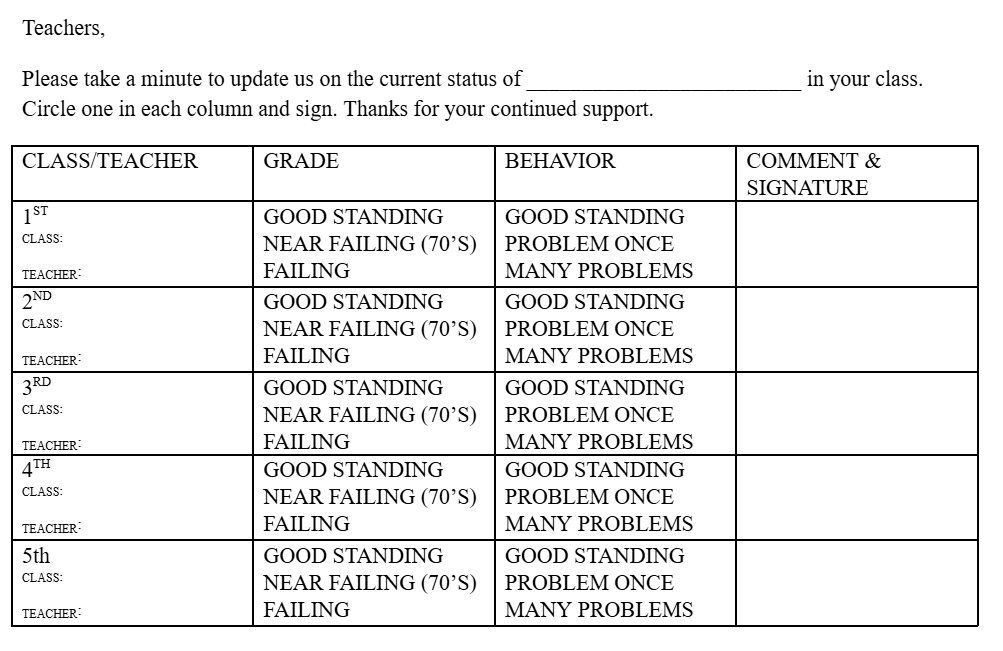
It is vital to the overall success of our football program and student athletes that students' grades be monitored throughout the entire school year by the football staff. This provides the coaches and players the ability to intervene and create a plan of action for academic success before a player’s grades fall to a level that is mathematically impossible to overcome. If a player continues to perform poorly in the classroom, after intervention from our coaching staff, the player may be subject to suspension from practice and/or games in order to better focus on their school work.
To ensure our students are performing well in the classroom, we will hold bi-weekly grade checks and quarterly teacher reports about each player. This approach allows us to support our student athletes and identify deficits and struggles they are having in class and seek or provide targeted intervention to improve our student-athletes grades. Along with grade check, we will establish a weekly study hall where our players can complete homework and receive additional support from coaches and teachers during this study hall.
The purpose of our weekly study hall is to provide our players with a block of time each week strictly designed for academic progress. We will reach out to teachers in our building to volunteer a short amount of their time to provide specific support in their respective disciplines.
Student-Athlete Progress Monitoring

Strength and Conditioning
PROGRAM OVERVIEW
This plan is designed to develop strength, speed, and power throughout the year while supporting player safety and performance on the field.
All players train the same core lifts, scaled to their ability. Lifts are based on percentages of the athlete’s three-rep max (3RM). Players will be divided into rack groups of 5–6 based upon their present levels of performance and rotate through stations efficiently. We will assess student achievement and growth in our strength and conditioning program multiple times through the year.
-
Goal: Build strength, size, and explosive power.
Schedule: 4 lifting days per week (Monday–Thursday)Mon: Lower Body (Heavy)
Tue: Upper Body (Heavy)
Wed: Recovery / Speed
Thu: Lower Body (Dynamic)
Fri: Upper Body (Dynamic or Hypertrophy)
December – Foundation Phase
Focus: Re-teach technique, improve mobility, establish a base.
Back Squat – 4x8 @ 60–70%
Bench Press – 4x8 @ 60–70%
Power Clean – 5x3 (light, form emphasis)
Deadlift – 3x8
Accessory Work: DB Rows, Lunges, Pull-Ups, Core Circuits
January – Base Strength
Focus: Build volume and work capacity.
Back Squat – 5x5 @ 70–75%
Bench Press – 5x5 @ 70–75%
Power Clean – 5x3
Front Squat – 4x6
Accessory Work: RDLs, Incline DB Press, Step-Ups, Face Pulls, Core
February – Strength Phase I
Focus: Max strength and stability.
Squat – 5x5 @ 75–80%
Bench – 5x5 @ 75–80%
Power Clean – 6x2 @ 70–80%
Push Press – 5x3 @ 70%
Accessory Work: Barbell Rows, Dips, Lunges, Pull-Ups, Core
March – Strength Phase II
Focus: Peak strength, prepare for spring football.
Squat – 5x4 @ 80–85%
Bench – 5x4 @ 80–85%
Power Clean – 6x2 @ 75–85%
Front Squat – 4x4
Accessory Work: RDLs, DB Bench, DB Rows, Core
Week 4: Deload week (reduce weight by 10–15%)
April – Power Phase
Focus: Transition strength into speed and explosiveness.
Power Clean – 5x3 @ 65–75%
Front Squat – 3x5 @ 70%
Push Press – 5x3 @ 70%
Trap Bar Deadlift – 4x4
Accessory Work: Step-Ups, Med Ball Throws, Chin-Ups, Core
Conditioning: Short sprints, sled pulls, jumps
May – Transition & Speed
Focus: Lighten load, increase mobility and conditioning before summer.
Squat – 3x5 @ 65%
Bench – 3x5 @ 65%
Power Clean – 5x2 @ 60%
Accessory Work: DB Rows, Lunges, RDLs, Core
Conditioning: Tempo runs, ladders, agility work
-
Goal: Maintain strength and power while limiting fatigue.
Schedule: 2–3 days per week (Monday/Wednesday optional Friday)June – Summer
Focus: Maintain strength and speed foundation.
Squat – 3x5 @ 70–80%
Bench – 3x5 @ 70–80%
Power Clean – 4x2 @ 65–75%
Accessory Work: Rows, Step-Ups, Core
Conditioning: Speed work and position drills
July – Summer
Focus: Keep strength, improve bar speed.
Power Clean – 5x2 @ 65–75%
Front Squat – 3x3 @ 70%
Push Press – 3x3 @ 70%
Accessory Work: RDLs, DB Bench, Pull-Ups, Core
Conditioning: Explosive jumps, sled work, med ball throws
August – Camp / Preseason
Focus: Maintain strength, reduce volume, and keep players healthy.
Squat – 3x5 @ 60–70%
Bench – 3x5 @ 60–70%
Power Clean – 4x2 @ 60–70%
Accessory Work: Lunges, Rows, Core
Conditioning: Done on field during practice
September – October (In-Season)
Focus: Maintain strength and stability.
Squat – 3x3 @ 65–75%
Bench – 3x3 @ 65–75%
Power Clean – 3x2 @ 65–75%
Accessory Work: Step-Ups, Pull-Ups, Core Stability
Bye Week: Optional heavier lift (75–80%)
November – Playoffs & Recovery
Focus: Stay fresh, avoid overtraining.
Squat – 2x5 @ 50–60%
Bench – 2x5 @ 50–60%
Power Clean – 3x2 @ 60%
Accessory Work: Bodyweight circuits, mobility work, light core
Community Involvement
Feeder Systems
A. Youth and Middle School Football Involvement
1. Open door policy for all coaches
2. Varsity coaches and players will be present during feeder program games
3. Youth Night and Middle School Night at home games (On field recognition)
4. Youth Camp
B. Community service for high school players
1. Toys for Tots
2. Volunteer to serve at school functions
Involvement with School Community
A. Teacher Appreciation Letters
B. Scout team Player of the Week
C. Alumni players invited to return and share their experiences with current team members
D. Visit feeder elementary schools (Reading, car rider line welcome, field day assistance)
F. Work with school school programs such as our Leadership classes and A/V program to get more students involved in our program outside of playing on the team.
Character Development
A. Community leaders speak to team
B. FCA speaker for pregame meals
C. Pre-Season Goal Setting
D. Youth Camp
Parental Involvement
A. Two parent meetings per year
1. Discuss goals and expectations
2. Review football calendar
3. Discuss college options
4. Organize volunteers
B. Communication through TeamReach/Team Stack App
Build Team Chemistry
A. Player Leadership Council
B. Connection Sessions
C. Team meals in offseason to build leadership
D. Player/Coach position meetings